By Sunny Hubler
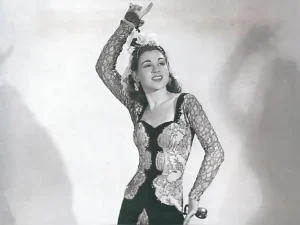
A petite but striking woman stands on a small stage, captured in soft-focus black-and-white film. She breaks into dance. The zapateado she uses—like tap, but faster and sharper—is impossibly quick. Its sound rings through the screen and across the decades.
The woman in the 1951 film clip is Inesita, a Spanish dancer whose life was inseparable from her gift and her art.
Inesita, whose legal name was Anice Dworkin, died last year on June 5. She was 102 years old. She passed away in her Los Angeles home, only a few months after giving her final flamenco lesson. She mentored and inspired countless students during a long career that spanned the globe.
Her nickname, Inesita, means “pure.” She earned it through her performances in the United States, Spain, the United Kingdom, France, and Mexico, as well as through her appearances in Hollywood films.
Born in New York City to two musicians and raised in Los Angeles from her teen years, Inesita began studying Spanish dance at 14 and was already performing in nightclubs in the early 1940s in her early twenties. She was considered primarily a neo-classical dancer and gained attention for her skill with castanets and for the precision of her footwork.
Hollywood Takes Notice
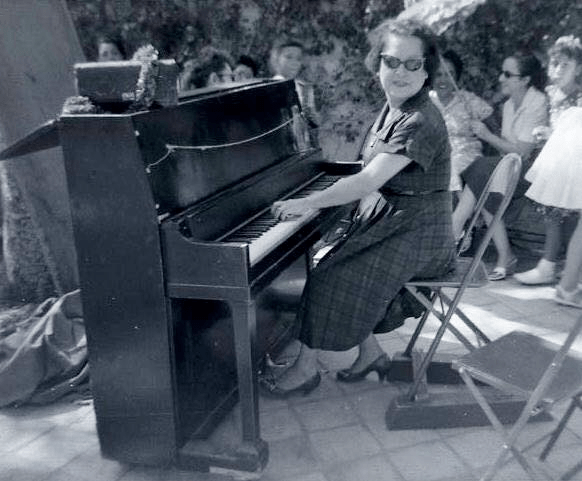
Hollywood soon took notice, featuring her in Starlight Serenade (1944), Tropical Masquerade (1948), Footlight Varieties (1951), and Here Come the Girls (1953), which starred Bob Hope. Her husband, Bernard (Bob) Dworkin—radio show producer for KFI and CBS—often served as her manager. She also appeared on television and performed live, frequently headlining her own tours, for which she hired singers, guitarists, and pianists. Her performances often included dances of the Bolero school, a slower form of Spanish dance with roots in Spain and Cuba, as well as her talents as a classically trained pianist and harpsichordist.
“The spirals [in flamenco] represent continuity, and that’s a very important word to use in connection with flamenco… the individual dies but the community lives on.”
These are Inesita’s words in Flamenco: The Enduring Art of Inesita, a 2016 documentary by filmmaker Christina Love.
Love said Inesita was a rare dancer: while she maintained the tradition of the centuries-old flamenco art form and worked within its improvisational style, she was always innovating.
“I was blown away that here is a woman in her late 90s, and she can still drop to her knees for her zapateado number! She never stopped learning and developing her arte, and she remained open to new influences. She told me, ‘Everything changes, but you have to move with the times.’ Her openness to evolution and her perseverance in dancing, I suspected, contributed to her longevity.”
In addition to performing, Inesita passed on her skills and knowledge to scores of future dancers. Those who worked alongside her or studied under her form a close-knit community.
“I found her dance journey, and the fact that she was still performing and teaching into her 90s and 100s, to be a great inspiration,” said Sarah Kruger, a friend and former student.
“Inesita said, ‘A lot of people say that dancers only have ten good years. This is a myth, and I am living proof.’ Apart from dancing and teaching, she was also an accomplished musician, keeping her mind and body sharp by playing her piano or harpsichord. She was highly intelligent and scholarly… basically, she was always doing something!”
Mystery of Flamenco
Much of flamenco is unwritten and open-ended, meaning the dancer must also be, as Inesita put it, “the conductor.” In Love’s documentary, she says, “Every time you finish a variation it opens the door for the next variation… Everything changes.”
That could have been the theme of her life. After many years of touring and dancing, she began to teach. Alongside extensive one-on-one mentoring, she developed a lecture series with her husband called “The Mystery of Flamenco.” She presented these lectures at schools and colleges.
“She paralleled flamenco to the cycles and seasons of life and nature,” Love said. “I had not heard that before and found it fascinating.”
“I think many dancers want to be part of that chain of experiencing and passing down knowledge from generation to generation,” Kruger said. “Having a teacher and watching a performer like Inesita, whose career across the decades witnessed the evolution of the dance form, adds knowledge, depth, history and understanding to one’s own flamenco journey.”
As Love’s documentary comes to a close, Inesita looks into the camera and says, “I think the word passion is overused a bit in flamenco… I would substitute the word power.”
For those who knew her and were touched by her, Inesita’s power remains a vital source. As an individual, she has died, but her worldwide community lives on.
Sunny Hubler is the editor of QC Exclusive Magazine of Charlotte, North Carolina. This feature is underwritten by the Journalism Arts Initiative.
Watch the 17-minute documentary below.