by Marco Aquino
A flamenco work shaped by color
At a glance
- Premiere: 2016
- Venue: Jo Long Theatre at the Carver Community Cultural Center, San Antonio
- Approach: flamenco in dialogue with visual art, modern movement, and spoken word
- Featured artists: Melissa Cruz, Illeana Gomez, and artistic director Tamara Adira
In 2016, Arte y Pasión premiered Colores, an ambitious evening-length production that treated flamenco not simply as dance, but as emotional pigment — layered, textured, and unapologetically human. Presented at the Jo Long Theatre at the Carver Community Cultural Center in San Antonio, the work expanded flamenco’s traditional vocabulary into a dialogue with visual art, modern movement, and spoken word.
Colores also featured flamenco dancers Melissa Cruz, Illeana Gomez and artistic director Tamara Adira.
Color, identity, and memory
At its heart, Colores explored how color shapes identity — culturally, spiritually, and politically. In that way, the production echoed the spirit of For Colored Girls Who Have Considered Suicide / When the Rainbow Is Enuf by Ntozake Shange, where color becomes both metaphor and testimony. Just as Shange assigned colors to women as embodiments of lived experience, Arte y Pasión used hue as an emotional landscape — red for passion, blue for longing, white for memory, black for ancestral weight.
There was also an undercurrent reminiscent of Colors, the 1988 urban drama directed by Dennis Hopper, which examined identity and territory through the symbolism of gang colors in Los Angeles. While vastly different in context, both works recognize that color is never neutral — it marks belonging, struggle, and social reality. In Colores, flamenco became the terrain where those emotional territories were claimed and contested.
Choreography and staging
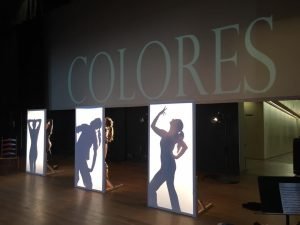
Tamara Adira’s choreography blended traditional flamenco structure with contemporary staging. Masked silhouettes moved behind screens; projected visual art washed the stage in shifting palettes; musicians layered classical strings with cante jondo. The result was immersive — at moments intimate, at others almost cinematic.
Why Colores still resonates
Yet what made Colores resonate most was its insistence that flamenco can hold many narratives at once. Like Shange’s choreopoem, it honored the multiplicity of voices within a community. Like Hopper’s film, it acknowledged that identity is shaped by history and environment. And like flamenco itself, it refused to flatten emotion into a single tone.
Watch the special 10th Anniversary Highlights video below. Explore more work from the festival in WeFlamenco’s Oral Histories archive.