The Austin musician crossed cultural and musical boundaries, becoming an integral part of San Antonio’s flamenco community.
By Marco Aquino
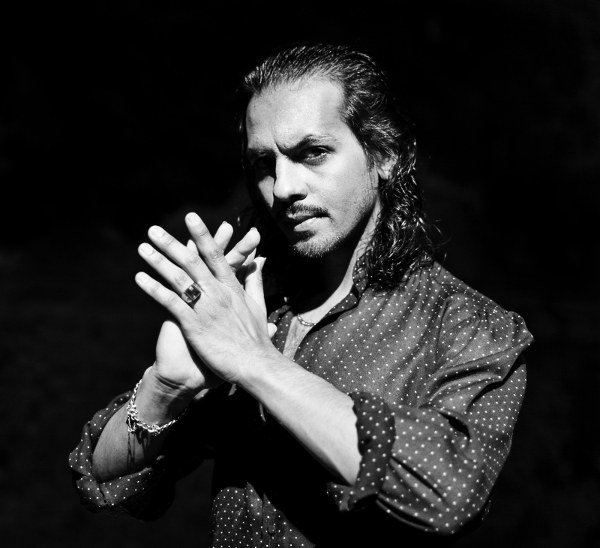
Austin violinist, composer and musical director Roberto Paolo Riggio, whose work bridged musical traditions and brought him into collaboration with artists across the globe, died September 28 at age 55. For San Antonio’s flamenco community, his death marks the loss of a musician whose presence helped shape some of the city’s most ambitious productions.
Born in Monterrey, Mexico, in 1971, Riggio grew up in Edinburg, Texas, before moving to Austin in 1989 to study music at the University of Texas. Over the following decades, he developed a career that crossed geographical, cultural and musical boundaries, drawing from Arabic, Hindustani, West African, Latin American and flamenco traditions.
Riggio was best known as the director of Atash, Austin’s award-winning world music ensemble, whose performances brought together musical traditions from across the Middle East and beyond. His career also included collaborations with internationally renowned artists such as Youssou N’Dour, Fairuz, Marcel Khalife, Simon Shaheen and Kazem Al-Saher.
But Riggio’s contributions extended beyond the concert stage. His work included composition, arrangement, conducting and collaborations with dancers, filmmakers and interdisciplinary artists.
In San Antonio, Riggio became a core member of Arte y Pasión, the multidisciplinary flamenco company directed by Tamara Adira. His violin helped define productions that pushed flamenco beyond conventional performance formats, incorporating contemporary dance, visual art, experimental music and socially engaged subject matter.
For Adira, whose productions frequently draw upon historical events and questions of cultural identity, Riggio offered more than musical accompaniment. His fluency across traditions allowed the company to explore the relationships between flamenco and other forms of artistic expression without reducing those traditions to decorative elements, or water-down ‘fusion’ styles.
Among Riggio’s final San Antonio collaborations was Sonidos de Libertad, presented at the Carver Community Cultural Center in 2025. The production brought together flamenco, music and performance art in a meditation on migration, displacement and the human desire for freedom.
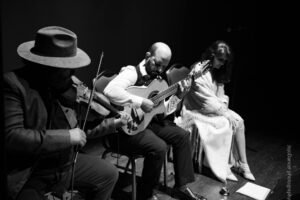
In Sonidos’ most striking scene, dancer Melissa Cruz drags Adira’s seemingly lifeless body across the Carver’s stage. The performance is accompanied by the music of guitarist Jose Manuel Tejeda, vocalist Celia Corrales, and Riggio’s violin. The performance addressed the many deaths from the TX abortion ban, inaction on immigration reform, and gun reform. Through music, movement and visual imagery, the production connected local tragedy to broader histories of human migration, suffering, and the constant threat of fascism.
Riggio’s participation was especially meaningful in a production that refused to separate artistic expression from contemporary human experience. His music moved between cultural traditions, reflecting the journeys and exchanges that have shaped them.
The production’s title, Sonidos de Libertad, or Sounds of Freedom, also provides an appropriate reference for Riggio’s larger artistic career. His work resisted the boundaries frequently imposed upon musical genres, allowing distinct traditions to coexist and communicate.
Austin flamenco artist Olivia Chacón, who collaborated with Riggio, was among the artists who remembered him publicly following his death. Her Facebook tribute reflected the personal and artistic connections he developed within the flamenco community.
Chacon wrote, “One of Roberto Riggio’s many special traits was his ability to bring people together for the sake of music… he acted as a bridge between almost every group having anything to do with world/global/traditional music in Austin.”
In her own Facebook tribute, Adira remembered Riggio as “unassuming, kind, full of warmth and gratitude.”
“He challenged himself to experiment and play, to always try new things. His art was infused with a profound love for humanity,” Adira wrote.
Those qualities were evident in a career built as much upon collaboration as individual accomplishment. Rather than remaining confined to one tradition, Riggio continually sought opportunities to work with musicians and artists whose backgrounds differed from his own.
His musical career also demonstrated the possibilities of an artistic practice grounded in cultural exchange. In an era when traditions are frequently categorized according to geography or ethnicity, Riggio approached music as a living language, one that could be shared without erasing the histories from which it emerged.
Riggio is survived by his wife, Sabrina, and daughter, Scarlette.
For the musicians and dancers who shared the stage with him, his absence will be felt in future performances. But his influence remains in the relationships he cultivated, the productions he helped create and the musical conversations he made possible.
Roberto’s violin carried the sounds of freedom—not as an abstract ideal, but as an expression of the possibilities created when artists cross boundaries and listen to one another.